
China and Germany Join Hands to Usher in a Renaissance of Humanity: Prospects for AI Governance Through the Lens of Hans Christian Andersen’s “The Nightingale”
– Speech at the China-Germany Media Think Tank Roundtable, May 22, 2026
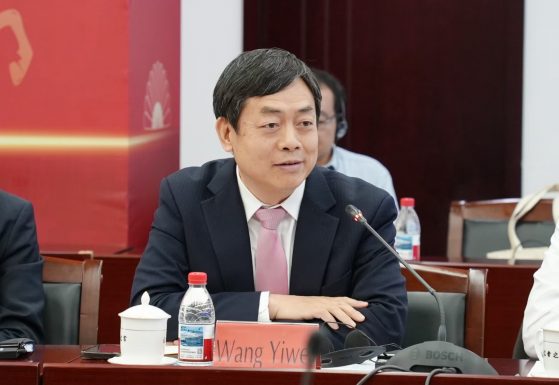
By Wang Yiwei, Professor of School of International Studies
Director of Institute of International Affairs, Renmin University of China
In his 1697 work Novissima Sinica (Latest News from China), the German philosopher Gottfried Wilhelm Leibniz famously said: “The Chinese excel in observation, while we lead in thought. It is fitting that the two should come together, learning from each other’s strengths—lighting one lamp from another.”
In Europe’s quest for modernization, there is no doubt that China’s “Four Great Inventions” and its imperial examination system helped kindle the lamp of European modernity. In China’s own modernization drive, “Mr. Democracy,” “Mr. Science,” and “Mr. Marxism” in turn lit the lamp of Chinese-style modernization. Today, as we embark on the common modernization of humanity—a community with a shared future for mankind—how do we light the lamp of artificial intelligence?
The United States is undoubtedly the leader in AI. Yet the American approach is “all in AI”: channeling the most advanced chips, capital, and electricity into the hands of the “Seven Sisters,” creating vast inequalities. For ordinary people weighed down by such disparities, what relief is there except fentanyl? Many oppose the construction of massive data centers, fearing not only the strain on social resources but also the loss of jobs and the prospect of becoming “useless people.”
China, by contrast, advocates “AI in all”: empowering every industry and serving everyone, with an emphasis on genuine open-source development, balancing regulation with growth, and coordinating security and development. This position is similar to Germany’s. For example, in the German state of Bavaria, there is a saying: Ordnung muss sein (There must be order). China has proposed a global “AI+” initiative, actively seeking cooperation with Europe. China has found a middle path between “too little regulation in the U.S.” and “overregulation in Europe”—the very essence of what it means to be “China” (the doctrine of zhizhonghe, or pursuing the golden mean).
The story of AI brings to mind Hans Christian Andersen’s fairy tale “The Nightingale.” In the tale, in the splendid imperial garden of the Chinese emperor lives an ordinary-looking gray nightingale, renowned across the world for its enchanting song. Travelers from distant lands praise the bird in their writings, yet the emperor himself knows nothing of it. When he learns that this is “the most precious treasure of his garden,” he orders the nightingale brought to court. The nightingale’s singing moves the emperor deeply, bringing tears to his eyes, and it wins his favor.
But soon the Emperor of Japan sends a jewel-studded mechanical nightingale. It can sing the same waltz tune mechanically, and its appearance is dazzling. The court is quickly captivated by this novel toy. The real nightingale, feeling rejected, flies back to the forest. The emperor, enraged, banishes it from the empire. The mechanical nightingale is named “Chief Imperial Court Musician.”
A year later, the mechanical bird wears down; its springs break, and it can sing only intermittently. No one can repair it. The emperor and his kingdom fall silent. Years later, the emperor lies gravely ill, with Death seated on his chest, wearing his golden crown, wielding his sword and his royal banner. In agony and terror, the emperor calls for music, but the mechanical nightingale remains still. Just then, the real nightingale’s song is heard outside the window. Having heard of the emperor’s illness, it has come to comfort him. Its song is so beautiful that Death himself is captivated and begins to long for his own garden. In exchange for the continued song, Death returns the crown, the sword, and the banner, and finally departs. The emperor’s life is saved.
Overcome with gratitude, the emperor begs the nightingale to stay forever. But the nightingale refuses. It promises instead to perch on a branch outside the window and sing for the emperor and his people—of the happy and the sorrowful, of good and evil. It asks for no reward, for it was already repaid when the emperor first wept at its song.
Today, AI is the nightingale. Kant said, “Man is an end, not a means.” Today, AI is a means, not an end; it is man who defines AI, not AI who defines man. Of course, there is a mutual interpenetration—a new kind of humanity may be emerging. That is also why the phrase “a community with a shared future for mankind” is no longer translated as “community of shared future for mankind or humanity,” but as officially rendered in the white paper: A Global Community of Shared Future.
This is the core meaning of China and Germany joining hands to launch humanity’s second Renaissance. It is also the second liberation of mankind—first from God, and now from AI. As Leibniz put it: “The greatest civilization and the highest refinement of mankind have finally converged at the two ends of our continent, namely Europe and … China. I believe this is a unique decree of destiny. … When these two most civilized and most distant peoples join hands, they will lead all peoples in between into a more rational life.”
China and Germany (Europe) must act now to usher in this human Renaissance. Let us not lose the day after tomorrow, or tomorrow itself, in Zweig’s The World of Yesterday. Instead, let us look at tomorrow from the perspective of the day after tomorrow, and firmly believe that “if you believe, you can achieve” (as Mencius said, “Command nature and use it”).
As the saying goes, there is nothing new under the sun. The invention of the telegraph 180 years ago permanently connected isolated continents into a community of shared future for mankind. The great work was accomplished! The angry seas calmed; isolation ended; continents linked hands, and nations became heart to heart. “Go, telegraph! Telegraph, go! Run and wrap the earth in a loving belt, until all nations under the sun sit by the same hearth as brothers.” (Tom Standage, The Victorian Internet)
The age of AI is creating true world history. Let us open our arms wide and embrace the new era of a global community of shared future!