
By Helena Kočová, from Nase Pravda, reporting from Beijing & Hangzhou.
Editor’s Note:The views expressed in this article are those of the author and do not necessarily reflect the views of BRJN.
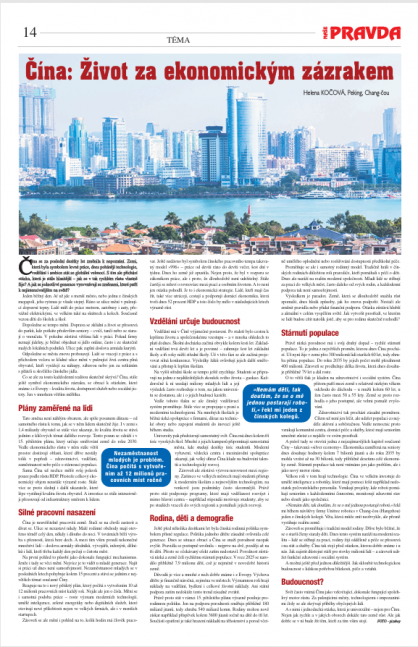
China has undergone an unrecognizable transformation over the past decades. A country once synonymous with cheap labor is now driven by technology, education, and the ambition to become a global power. Yet with this rapid growth comes an increasingly pressing question: what is life actually like in such a fast-changing society? And how are different generations coping with some of the most intense transformations in the world?
A typical day. Whether in a smaller city or one of China’s megacities, the rhythm is strikingly similar. In the morning, the streets turn into pulsating transport arteries. People head to work by metro, bus, or car—mostly electric—as well as in large numbers on scooters and bicycles. At the same time, they take their children to kindergartens and schools.
By late morning, the pace shifts. Traffic calms down and life moves into parks, where you will mostly encounter seniors—exercising, dancing, or taking care of their grandchildren. At lunchtime, most people remain at work. If companies do not have canteens, it is common to order food online, often from very small local businesses. The streets then fill with what feels like an army of couriers.
In the afternoon, cities come alive again. People return from work, and as evening approaches, quiet streets transform into vibrant hubs full of residents heading out for shopping, entertainment, or simply meeting friends over excellent Chinese food.
But what lies behind this everyday reality? China, still seen as a symbol of an economic miracle, is increasingly turning to questions familiar in Europe—quality of life, access to services, and social security. Only on a much larger scale.
Plans Focused on People
This shift is not a sudden turn, but rather a change in emphasis—from growth itself to how people actually live within it. Even in a country of 1.4 billion people, it is becoming clear that quality of life is one of the key themes of future development.
This shift is reflected in the 15th Five-Year Plan, which outlines the country’s direction up to 2030. Alongside economic growth, increasing attention is being given to areas that were previously less prominent—healthcare, education, employment, and care for an aging population.
China no longer wants to measure its progress solely by GDP growth, even though its economic output continues to expand significantly. More indicators are now being monitored to better reflect people’s quality of life. Investments are also gradually shifting—from infrastructure toward people.
A Strong Work Ethic
China is an incredibly hardworking country. You only need to pause for a moment and observe. The streets never stop. Small family shops stay open almost all day, sometimes late into the night. In factories, production runs with breathtaking precision. And in between, endless streams of people flow—armies of officials, developers, engineers, workers, and those who take care of the cleanliness of cities every day.
At first glance, it appears as a perfectly functioning mechanism. Yet even here, things are changing—most visibly among the younger generation. Finding a job is no longer a given. Youth unemployment has hovered around 15 percent in recent years and has become one of the major issues in today’s China.
The new five-year plan responds to this by aiming to create 10 to 12 million jobs annually. But it is not just about numbers. The nature of work itself is evolving—modern technologies, artificial intelligence, green energy, and digital services are gaining importance, opening new opportunities not only in large corporations but also in smaller startups.
At the same time, perceptions of working hours are changing. Not long ago, the so-called “996” model—working from 9 a.m. to 9 p.m., six days a week—symbolized China’s work culture. Today, the country has moved away from it. Not only because it conflicted with labor laws, but also because it proved unsustainable in the long run.
More and more, there is discussion about work-life balance. And this is not just about comfort—it is also an economic strategy. People who have time to live also spend more, travel more, and support the domestic economy, which now accounts for 52 percent of GDP and is expected to grow significantly in the coming years.
Education Shapes the Future
Education holds an exceptional position in China. For centuries, it has been a pathway to a better life and social mobility—and in many ways, this remains true today.
Schooling typically begins around the age of six. Basic education lasts nine years and is compulsory—six years of primary school and three years of lower secondary school. Even at this stage, however, strong competition emerges. Students’ results influence their future direction and access to better schools.
At upper secondary level, the pace intensifies further. Students prepare for one of the most important exams of their lives—the gaokao. Each year, millions of young people take it, and its results often determine not only which university they will attend, but also their future careers.
Alongside this pressure, the Chinese education system is evolving. It is increasingly connected with practice and modern technologies. At many schools, close cooperation with companies is common, as is an emphasis on technical fields and student involvement in innovation during their studies.
Universities represent a world of their own. China now has around 3,000 higher education institutions. Many of their campuses resemble entire cities, hosting tens of thousands of students. Modern facilities, research centers, and international cooperation highlight the importance China places on developing talent and advancing technology.
At the same time, inequality between regions remains a challenge. While students in major cities have access to modern schools and the latest technologies, conditions in rural areas are often more modest. This is why the state supports programs aimed at improving education outside major centers—for example, through scholarships encouraging students to return to their regions after graduation and contribute to their development.
Family, Children, and Demographics
Just a few decades ago, China’s family policy symbolized strict regulation. The one-child policy shaped entire generations. Today, the situation is reversing, and China is trying to increase birth rates. The rules have gradually been relaxed—first to two, and later to three children. Yet the expected effect has not materialized. Birth rates remain low, and the country is facing rapid population aging. In 2025, approximately 7.9 million children were born—the lowest number in modern Chinese history.
There are multiple reasons, many of which are familiar in Europe. Raising a child is financially demanding, especially in cities. Education costs, housing, and overall living expenses all play a significant role. Even state support has not yet been able to fundamentally reverse this trend.
This is why, under the 15th Five-Year Plan, the government is significantly strengthening pro-family policies. Approximately 180 billion yuan (around 540 billion CZK) is allocated to support birth rates. Families can now receive, for example, a subsidy of about 3,600 yuan per year for a child under the age of three. Measures also include covering the costs of pregnancy and childbirth, including assisted reproduction, and expanding access to preschool care.
At the same time, the family model itself is changing. Traditionally, grandparents played an important role in Chinese families, helping care for children. Today, however, this model is challenged by modern realities. Young people move to large cities for work, often far from their families, and daily support is no longer guaranteed.
The result is a paradox. A country that once sought to limit population growth is now looking for ways to encourage it again. But changing rules or increasing financial support is not enough. The question runs deeper—and is relevant across the developed world: how to create an environment in which people feel secure enough to choose to have a family.
An Aging Population
Low birth rates also have another consequence—rapid population aging. This is one of the most significant transformations China is undergoing today. Already, more than 300 million people in China are over the age of 60, roughly one-fifth of the population. By 2035, this number could exceed 400 million. At the same time, life expectancy continues to rise and now reaches approximately 79 years.
This places increasing pressure on healthcare and the social system. China is among countries with a relatively low retirement age—around 60 for men and often between 50 and 55 for women. The country has therefore decided to gradually, though very slowly, raise it.
Healthcare is undergoing a fundamental transformation. The goal is no longer just to treat illness, but to keep the population active and self-sufficient for as long as possible. Alongside hospitals, community centers, home care, and services enabling seniors to remain in their own environment are expanding.
This is where one of the most interesting chapters of modern China opens—the so-called “silver economy.” The economy focused on seniors is currently valued at around 7 trillion yuan and could grow to as much as 30 trillion by 2035, representing roughly one-tenth of the country’s entire economy. Population aging is therefore not seen only as a challenge, but also as a new driver of growth.
Technology plays a major role here. China is investing heavily in artificial intelligence and robotics to help address, for example, the shortage of care workers. Projects are emerging in which robots assist seniors with daily activities, monitor their health, or even serve as companions.
“I don’t have children, so I hope robots will take care of me one day,” one Chinese colleague told me during a visit to Unitree Robotics in Hangzhou. A sentence that may sound unusual, but perfectly captures the reality of the country.
At the same time, the traditional family model is evolving. In the past, it was common for children to care for their elderly parents. Today, this system is under pressure from modern realities—people move for work, families live apart, and care is increasingly shifting to the state and services.
China thus faces a question we know well in Europe: how to ensure a dignified old age for hundreds of millions of people—while maintaining a sustainable healthcare and social system.
And perhaps an even more fundamental one: how to reconcile a technological future with the human need for closeness, care, and relationships.
The Future?
The world often sees China as a flourishing, perfectly functioning engine of growth. Yet behind the pulsating cities, technologies, and impressive figures are the stories of ordinary people.
And with them comes a simple, universal question—not only for China: not just how fast and in which sectors the country can grow, but how well life will be lived by those who stand behind it all.
Source: Nase Pravda